



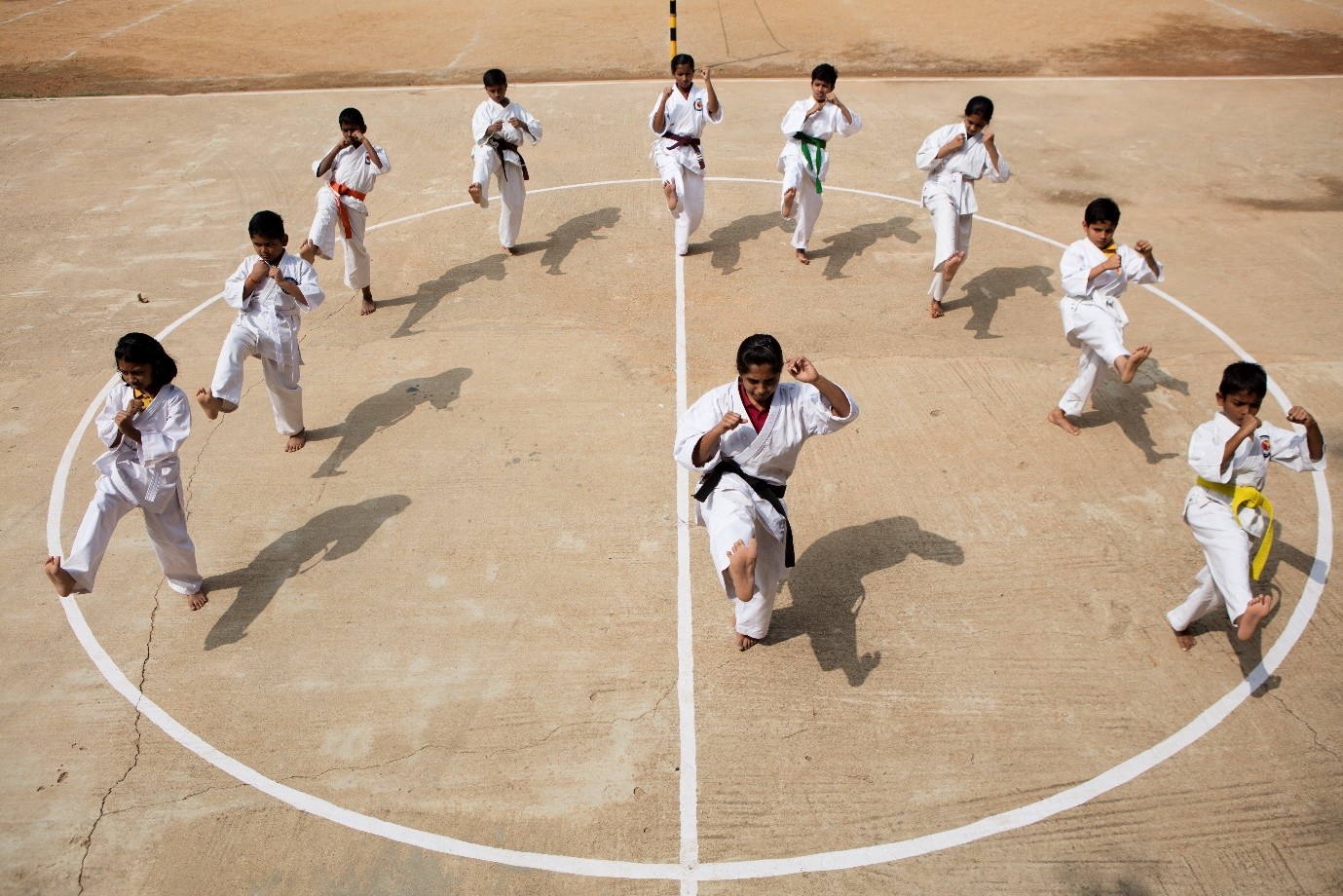
Middle school is a strange, wonderful, sometimes bewildering stretch of time. Your child isn't little anymore — but they're not quite a teenager either. They're figuring out who they are, what they like, who they want to be around. And honestly? So are you, as a parent. You're figuring out what kind of support they need now that they're more independent but still very much in formation.
This is exactly when extracurricular activities matter most. Not as resume-builders — that comes later. But as spaces where your child can try things, fail at things, get better at things, and discover parts of themselves that a classroom alone can't reveal.
A well-rounded education has never been just about marks. That's something Vidyanjali Academy for Learning has believed since 1992. The school's philosophy is clear: "Vidyanjali is more than just a school — we focus on development of body, mind, and spirit." Extracurricular activities aren't extras here. They're woven into how learning happens.
How Do Extracurricular Activities Benefit Middle School Students Academically?
Here's something that surprises many parents: students who participate in extracurricular activities often perform better academically. Not despite the time commitment — because of it.
A study from NYU found that participating in extracurricular activities in the community, such as volunteering, was most highly associated with better academic performance among middle schoolers.
Better Focus and Classroom Engagement
Physical activity, creative expression, and leadership roles all contribute to better focus in the classroom. A child who has burned off energy at basketball practice or channelled emotions through drama is often more present, more attentive, and more willing to participate in class discussions.
Teachers notice this. Parents notice this. And eventually, the child notices it too.
Academic Correlation Studies
Data from the National Center for Education Statistics (NCES) shows that extracurricular activities offer opportunities for students to learn the values of teamwork, individual and group responsibility, and endurance — all of which correlate with improved school engagement and reduced dropout rates.
What Social and Emotional Skills Do Students Gain From Extracurriculars?
If academics are one half of the equation, social and emotional development is the other. And honestly — this is where extracurriculars shine brightest.
CASEL (the Collaborative for Academic, Social, and Emotional Learning) identifies five core competencies: self-awareness, self-management, social awareness, relationship skills, and responsible decision-making. Extracurricular activities touch all five.
Confidence, Teamwork, and Leadership
When a child performs on stage, scores a goal, or leads a club meeting, something shifts inside them. They realise they can do hard things. They learn to work with others who think differently. They discover that leadership isn't about being the loudest — it's about being reliable.
These aren't lessons you can teach from a textbook. They have to be lived.
SEL Benefits According to CASEL
According to CASEL, social and emotional learning helps young people thrive personally and academically, develop positive relationships, and become lifelong learners. Extracurricular activities are one of the most natural settings for this kind of learning to happen — because the stakes feel real, the relationships are genuine, and the feedback is immediate.
How Many Extracurricular Activities Should a Middle Schooler Be Involved In?
This is where I'll be direct: quality matters more than quantity. An overscheduled child is a stressed child. And stress undermines everything extracurriculars are supposed to provide.
Quality Over Quantity
Two or three meaningful activities are better than five superficial ones. Deep engagement builds skills and relationships. Surface-level participation builds nothing but exhaustion.
What Role Do Parents and Schools Play in Encouraging Extracurricular Participation?
Both matter. Parents provide encouragement and logistical support. Schools provide access and opportunity.
Creating Supportive Environments
Encouragement looks like showing up to performances, asking about practice, celebrating effort (not just results). It means letting your child know that trying something new — and possibly failing — is okay.
Helping Children Discover Interests
Pay attention to what your child gravitates toward. What do they talk about? What do they watch? What do they doodle in the margins of their notebooks? These are clues. Follow them.
What Makes Vidyanjali Academy the Best School for Extracurricular Development?
Vidyanjali Academy for Learning has been committed to holistic development since 1992. The school's philosophy is clear: "Every child is unique and different, but there is a genius hidden in each one of them." Extracurricular activities are how that genius gets discovered.
Overview of Programs Offered
Vidyanjali offers a comprehensive range of extracurricular programmes:
Sports and physical fitness — including basketball, kho-kho, and volleyball on the school's own playground (the only school in R.T. Nagar with its own playground)
Performing arts — music, dance, drama, and cultural activities
STEM and innovation programmes
Debate and public speaking through the Rhetorics Gavel Club
Leadership development and community service
Student Success Stories
Students at Vidyanjali regularly participate in competitions, performances, and leadership roles. The school has been recognised for Excellence in Lifeskills and Activity Based Learning (ELDROK India, 2024-25) and received the CBSE Parameter-wise Award for Student Advancement and Mentoring (India School Merit Awards 2025).
Integration Into School Philosophy
At Vidyanjali, extracurricular activities aren't optional add-ons. They're built into the educational approach. The school's core values — Caring, Respect, Responsibility, Courage, Fairness, Perseverance — are lived out through activities, not just taught in classrooms.
Parental Feedback and Testimonials
Parents consistently describe Vidyanjali as "A Home away from Home." One family noted that the school provides "a well-designed bundle of values, principles, and etiquette." Another emphasised that "children self-guide their learning and enjoy the process."
These aren't marketing phrases. They're what parents actually experience.
Leadership, Innovation, and Student Support
The school's commitment to mentorship is reflected in its faculty: 60% hold master's degrees, 81% are trained, and 44% have over 10 years of experience. As the school puts it: "Our teachers are not just teachers but mentors and illuminators for students."
Are After-School Programs Effective for Middle Schoolers?
Research says yes. Harvard Graduate School of Education confirms that a decade of research supports the positive benefits of afterschool programmes.
Structure and Supervision
Well-designed after-school programmes keep students engaged, safe, and productive during the hours when unsupervised time can lead to problems. They provide structure without the pressure of formal academics.
Extended Learning Time
After-school clubs and enrichment programmes reinforce what students learn during the day — and extend it in directions that classroom time doesn't allow. A robotics club can go deeper into engineering concepts. A drama programme can explore literature through performance.
How Can Students Choose the Right Extracurricular Activity?
This is a process, not a decision. Middle school is the time to explore.
Identifying Passions and Strengths
Start with questions: What do you enjoy? What are you curious about? What do you want to get better at? The answers don't have to be certain — they just have to be honest.
Trying Different Activities
Encourage your child to try multiple activities before committing. It's okay to join something for a term and decide it's not right. That's not failure — that's learning.
Guidance From Mentors, Teachers, or Counselors
Teachers and counsellors often see strengths that students don't recognise in themselves. A conversation with a trusted adult can open doors a child didn't know existed.
Explore Extracurriculars at Vidyanjali Academy
If you're looking for a school that takes extracurricular development as seriously as academics, Vidyanjali Academy for Learning is worth exploring. With over 30 years of experience, a 55,700 sq.ft. campus with its own playground, and a philosophy centred on holistic growth, Vidyanjali offers the environment your child needs to thrive.
Visit the campus. Talk to the teachers. See the activities in action. You'll understand why parents describe it as "A Home away from Home."
Contact Vidyanjali Academy for Learning:
Phone: 9008202222
Email: info@vidyanjali.in
Address: Opp SBI Bank, Cholanayakanahalli, R.T. Nagar, Bangalore – 560 032
Office Hours: Mon–Fri 8:30 AM–4:00 PM, Sat 8:30 AM–12:00 PM